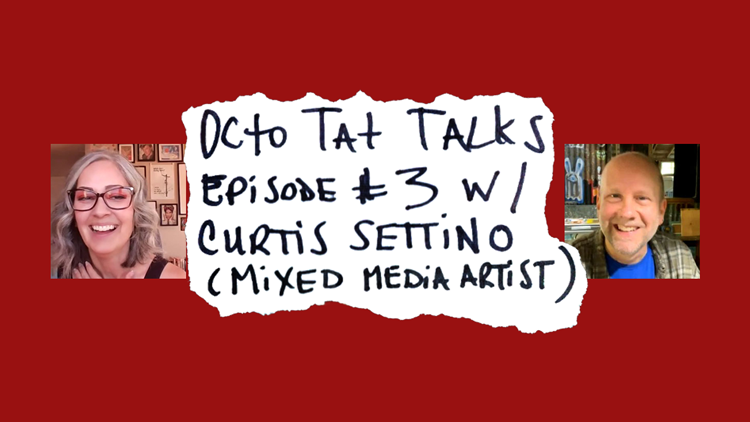
OCTO TAT TALKS EPISODE 3:
Curtis settino
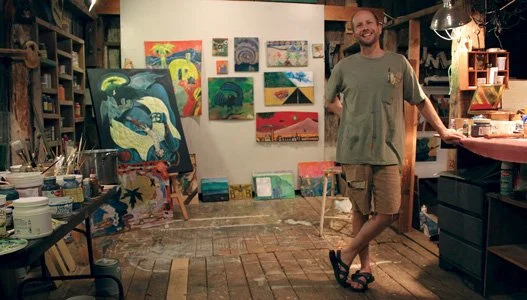
It’s time to hear about the Horse Fish that helped kick-start Curtis Settino’s artistic career and how this mixed media artist finds inspiration in everything from Aardvarks to Zappa.
You can download the audio version, watch the video or read the transcript.
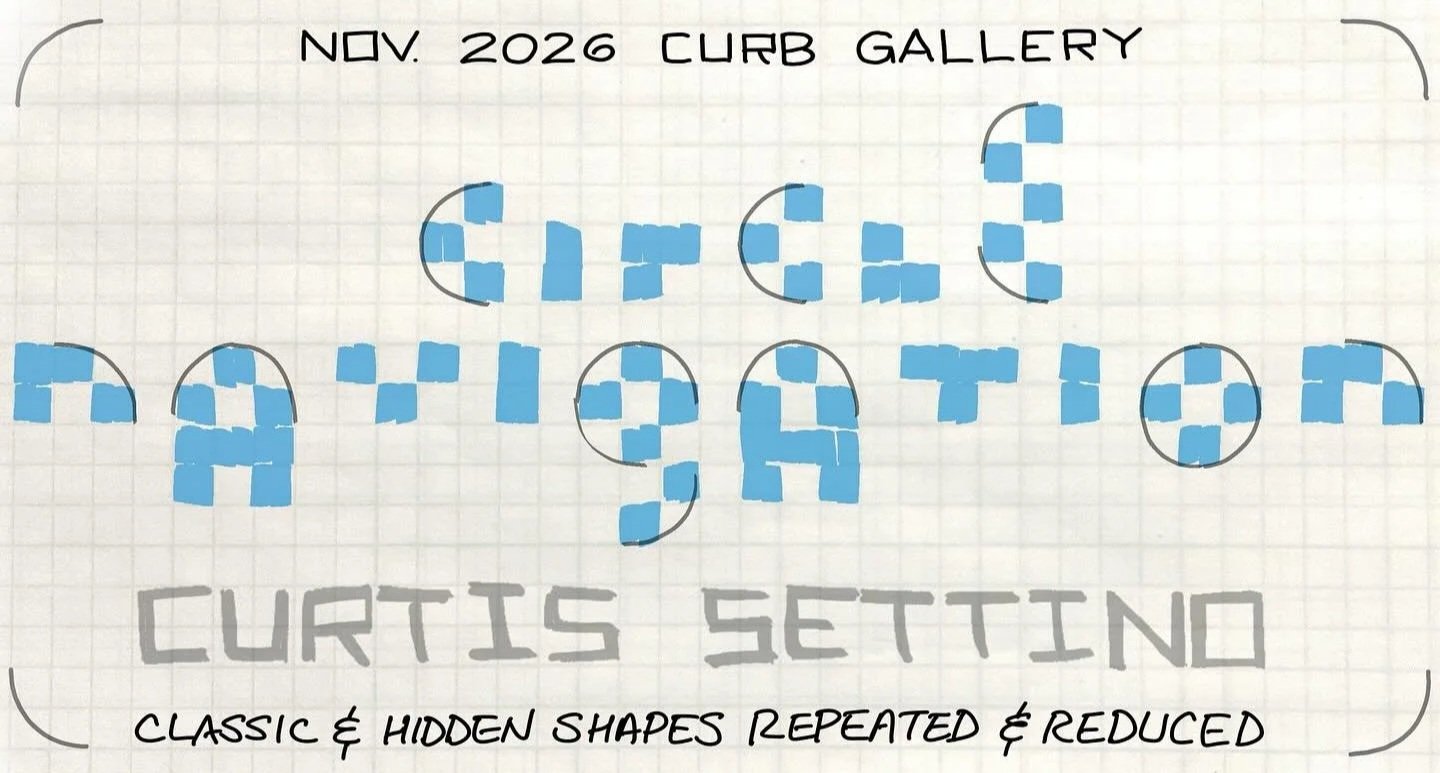
Join Curtis at Circle Navigation opening November 5 at 4 PM at Curb Gallery on 424 NW 12th Ave. in Portland, OR 97209.
Related Links:
More About Octo Tat Talks:
This is the first project I’ve launched without having a full brand strategy and a plan to ensure everything published is polished. I wanted to challenge myself to do something that felt a little scary. Something I wasn’t an expert at. Something that would stretch my brain. Current status? I’m learning a lot and I’ve still got a lot to learn. If you’d like to help me with my experiment, reach out to me on LinkedIn.
DOWNLOAD THE AUDIO:
Heads Up: I still haven’t invested in a good mic yet, so the sound quality isn’t the greatest. Also, you’re gonna miss out on all of the visuals of Settino’s awesome art with this version.
WATCH THE VIDEO:
READ THE TRANSCRIPT:
KATE: Welcome to episode three of Octo Tat Talks.
I'm joined today by Curtis Settino, who is a mixed media artist and interactive developer, which means you do paintings, you do sculptures, you do traditional art prints, drawings, films, animation, music, stories, you do a little bit of everything.
You're just a creative dude, huh?
CURTIS: Yeah.
KATE: Based in Portland and uh so you're a member of the CoVault Artists Network and also--I just learned this when I was looking at your bio recently--improv songwriting teacher at Arts for Learning Northwest. So you've got all the artistic things going on for you here.
So I'm really excited. You've got a show coming up at Curb Gallery called "Circle Navigation." And now we're going to do the fun part where I attempt to share my screen and hope that I don't mess it up.
So, we're gonna we're going to give this a shot. This is happening November 5th is when you open up four o'clock and that is at Curb Gallery in Portland, Oregon.
Talk to me about this tool that I'm looking at here.
CURTIS: Well, this is the original uh circle template that I was gifted when I entered college or maybe the end of high school. I'm not 100% uh on that timing, but it's been with me forever and I've always, you know, used it in a lot of artwork. I incorporate geometric shapes into a lot of my work. Um so that thing has just been handy and around and I was finally looking at it thinking there's got to be something else in here um other than circles.
And so I just started doing what this red line is doing. Just playing with it and seeing what I could pull out of it that was of interest to me. Uh and then I made stencils from these different shapes that uh the outlines are showing here and uh just started doing art and to see what would happen. So it was it was a real fun sort of start. And then at one point I did actually use the um circle template as a a stencil and I spray painted it a little bit. Luckily, I had the right side up so I didn't obliterate the numbers for everything. But uh um it was sort of a a moment of and I always say this to myself just to be bold in the studio because I was like, "Oh, this thing's so precious. I've had it for all these years. I shouldn't ruin it at all." But I was like, "No, I need this now. Let's just do it." And like I said, it's still usable. But it was it was nice to sort of catch myself in that moment being precious and then saying, "Screw it." Like "You got to just do it."
KATE: Absolutely. And you know that's kind of what what we're getting a chance to look at here in some of these examples from a piece you were working with uh using all those stencils. Uh and so tell me about this. Tell me about this process.
CURTIS: Yeah, this one actually was a real late in the game one. I've been working on stuff for this show since January this year and I didn't even know what I was doing. I just started playing with the gelli plate uh which everybody was talking about. So I did some research and bought myself one and just started making images with it. And then the circle template thing sort of developed from uh that needing more shapes to play with. And so I have all these templates or masks, however you want to look at it, um stacked up around the studio. And this particular image here was literally just a pile of stencils lying on the table that looked cool. I liked the arrangement, how it looked like kind of a psychedelic lollipop or something. And I thought, well, don't move it. And so for a couple days, I left. I kept it in its position and just kept eyeballing it, thinking about it. And then I finally said, "Oh, I know what I need to do." And restacked the order. Kept everything in the exact same positions, but realized if I wanted it to look as it does, a little bit like like an ice cream cone or like a stick that hold is holding a a gobbledygook of something, I would need to do it in a certain sequence with a certain colors and certain orders, blah blah blah. So, I just I rearranged it, got the paper, boom, boom, boom, boom, boom. Thought it'd be a fun thing to process. So, or or to capture the process of. So, I took these photos, which I hate to do because it's it just interrupts the flow and I don't know how anybody does this stuff 24/7 for Instagram or whatever because it it just really is a disruption uh most of the time. Anyway, so I just bang this thing out. Very excited to to find yet another shape of sorts out of shapes. And uh that's basically the story of this piece.
KATE: I love that. And I love what you said about Instagram, too. I I meet so many artists who will ask me "What should I be doing on Instagram?" and and I say I can tell you how you can be successful on Instagram, but I can also warn you that maybe that's not where you want to be because the answer really is to be successful on Instagram, you kind of have to live there. Yeah. You it has to be a a major part of your daily process, right? and and um and it can you can integrate that in a way into your day-to-day where it still feels natural, but it it is you have to be careful not to let it uh let it take over what you wanted to promote to begin with, right? Have you have you found how have you found your balance there? Because you do a great job of like keeping people up to date and what's going on and and sharing some of your work, but it it also doesn't seem like, you know, it's it's your your only outlet, which for some people it seems like unfortunately becomes that way.
CURTIS:Yeah, it's it's a real time suck. Um and you know, luckily or not, I don't have a bunch of followers. Like people aren't clamoring um for what I'm up to. Uh, but I do have friends who keep keep touch um either on Instagram or Facebook because everything I post there just goes straight to there as well. Uh, and so I've given myself a rule that when I'm looking at Instagram, I only look until something makes me smile or laugh and then I get off. Um, and when I'm posting, I I make sure I have three things to post. I like to post in sets of three because the my Instagram feed is sort of a piece of art as well. If you look at it, it's all chunked out that way, which to me is just an amusing thing to do, but also a nice limitation or direction that keeps me from uh wandering about. Uh and then so when I do post, that's often maybe once a week, maybe maybe more than that if I feel like I have something to share. Certainly leading up to a show, I'll be posting more. Soon as the show is down, I will probably go silent for a month or so. Um, just because I don't need to do it and um there probably won't be much creative stuff going on with the art at that point. Um, but it is I I I do find it to be interesting to see all the process stuff and people respond to those photos and videos the most. So, that's kind of what spurs me on to do do any of it um process-wise. Um, but it is, like I said, it is a big disruption and I I have to be careful about how I manage that because I don't want to I don't like holding the phone all the time and uh you know it I don't know what else to say about that but it's just it's interesting being old enough to have all these different things that have happened technologically. You know, when I was a kid, I had a pencil and a crayon and a paper and the radio and then later on, you know, television could be on in the background or the or, you know, now a stereo and then now the computer or a laptop or this iPad or my phone and so it's like uh all these things and it it's nice to have a studio space where you can't get all that but over the years all that stuff has crept in here. So, I I do have to be diligent about managing how much television I have on or videos or music or records or whatever it is.
KATE: Yeah. Yeah. No, I I think that's I think it's spot on is it's about finding that balance. Um because I mean thankfully you were on Instagram because that's how I found you. Yeah. But uh you know so there's there's there's absolute uh positives to to interacting with it but it is it is it is that delicate dance of of trying to make sure that it's it's there and being helpful and not taking over. Um it's not it's not about banning abandoning it completely. It's about learning how to work with it instead of having it work you I guess.
CURTIS: Yeah. And I I do treat it like a pin like a a pinup board. you know, it's really for me to track things and I I do go back through my feed often and just kind of uh see its rhythm and and it's in its ebb and flow of things and it's been very helpful just for myself to be just to keep track because I make a lot of art and uh I have for years. So to have sort of one place where it's kind of collected that's easy to kind of spizz through and be reminded of it or just remember because I'll go through my studio and I'll be like did I ever post a picture of this and I'm not 100% sure sometimes because I'll bang something out boom boom boom put it away and then I will forget. I'll be on to new things and then a year later I'll be like "Oh right! This is all right. Maybe it's not quite done but did I ever share it with anybody? No idea."
KATE: Right. Right. Well, I've got a few pieces uh that you're gonna have available at your show um that I wanted to to go through and if you have any words to share about these as I pop through.
CURTIS: Sure. Yeah, this was uh so there uh the silly thing about the show is since I've been working since January, I've made a lot of stuff. I've made 250 pieces of 8 and 1/2 by 11 art plus other stuff that's not 8 and 1/2 x 11 that just got removed from the offering um because I wanted to stick with something consistent. Um doing these landscapes. You can see clearly there the the pieces I've pulled or the template shapes that I've pulled from the circle template as the sky. Um I just again I just wanted to play with these colors and with these shapes and I thought um I've been spending a lot of time in Palm Springs taking care of some uh some family estate stuff and uh the mountains there are like this. They're very uh cooked and uh and the skies can be California beautiful and amazing much like we have here in Portland today, surprisingly just gorgeous weather up here. Um and uh so I made maybe 20 of these sorts of landscapes. Um playing with what shapes to start with first, how obviously I'm trying to emulate clouds of some sort. And then some of these I got done with them and I didn't like how they fit in the 8 1/2 x 11 format compositionally. So I sliced them up a little bit and flipped things around.
So this one here you can see on the left side has slices of what's actually the right side flipped upside down and and then interspersed. Um so I did that for a few of them and then the the bottom part. So I do the sky part first on these and then I have a template. It's it's literally just a piece of cardboard that's cut into this range shape. Um, it's got a negative and positive shape of that on both uh the top and bottom. Uh, so I can mask it for the sky or I can mask it for the earth. And I I I just throw a bunch of grass on there after I mask it off just literally from the lawn. Um, hit it really close and hot with uh the spray paint so it's juicy. And then grab the whole thing and just slide it off of the paper. And then you can see a little bit of those striations here.
Um, you just never know what you're going to get, which I love after being so kind of calculated with the sky in a in a sense, even though it looks chaotic. It's very orderly and processed. And then the earth is just chaos and it's fast and you have to just you you have a second, you know, to get that spray paint off before it just it locks down. So, that's how all these uh landscapes that I've done have have been created. And while I was in the process of doing these, other stuff started popping out of my head that I could do also that wasn't necessarily related to the circle template, but to spray painting and stenciling and stuff. And so, a lot of the show is actually veered away from the circle template as its true source, but has been inspired by that exploration.
Okay, I sound like I know what I'm talking about. This is funny. Like,
KATE: It does. What What's going on here? You might you might need to do this for a living.
CURTIS: Well, I never tell I never say much about it to people uh until it's time and I'm musing on it the whole time I'm working on it. But when this was coming up to talk with you and thanks for the invitation, I I love it. It it's it's really exciting to have a strange stranger reach out to you and you know want to talk shop. Um but then I was like "Oh, Christ! What is this show about? I don't really know!" And then I see so it made me really focus on it. And Circle Navigation is perhaps not the most exciting title. Um but it's it's clear as far as like the source of this thing and um but it's not fun. It's not sexy. It's not you know like no one's going to sing a song about it. Um maybe but it's just it just seems sort of like perfunctory and like let's just get a title down and move ahead here. Um, so anyway, the musing that I'm just rambling up about now and and through this is just it hasn't really been practiced or thought out or ever said. So I'm I'm just enjoying the fact that it's in there because I've been paying attention subconsciously since January about what I'm doing and what it means and what my rules are for this show uh and what my hopes are for it uh when it's hung basically.
KATE: Yeah, that's great. So we've got some more fun pieces here. Um, I love this. I love your cat. Tell me about this cat.
CURTIS: This is Nino, named after Nino Rota, the composer of all the Fellini films and a bunch of other stuff. Um, this cat is Italian, if you can't tell. Uh, he's a tricky dude. Um, and here he's giving you the psychotic look, which he likes to do. We don't know why he does this, but it seems to happen. It's all the time. He's just got this bonkers, insane look. Um, so I took a photo of him, a bunch of photos of him until I got one that I could work with and then worked uh, you know, turned it into an illustration, cut it up in plastic stencils, uh, and I just made a whole there's a ton of him and his his brother Buster also appears in a bunch of pieces. Um, but gelli plate on the bottom of this one, the the the or uh, the reddish orange actually there's no red in the show at all, but there's kind of a a heavy orange I used. So I would make a bunch of these backgrounds with varying gelli plate um you know the shapes the same but how the color went on I would always be a little different. So I'd bang out maybe 8 of these at a row at a time maybe 10 line them up on the wall and then start figuring what goes on top what's next and bit by bit that's how these things develop. So this one I knew I was going to put Nino on uh couple stencils dun dun dun and then I thought for week what else? and then custom stencils for the sort of uh triangle shape. And then that uh the uh the rings uh of the circle rings emanating out. Um it's from a some stencil that I just got in an estate sale. So pretty straightforward on this one. This is a I would say a simple one.
KATE: Love it. And then we've got this guy.
CURTIS: Yeah. So the uh the background is uh I call it chain link flowers and it's from a drawing I did in a book three years ago at this point. I'm not something like that. I was doing I tried to do a whole fill this whole black book with a uh fantastic flora and um this was one of the designs that came out of it and I just liked it and when I started playing around with the gelli plate I thought here's an image that could work well. So, I turned it into stencils and I there's also going to be a lot of just the chain link flower images in the show. Multiple variations on the colors and the flowers and the leaves and the background. A lot of variations. Um, and then this is a one-off uh hybrid of the DNA flowers with the chain link flowers. And again, just playing in the studio. I've got all these different collections of stencils going. Um, and so what happens when they start playing together? Some of them like each other, some of them don't. And this one, I think, turned out pretty fun and punchy. So, I think it's going in the show.
KATE: That's great. And then there's one that will not be in the show.
CURTIS: No
KATE: Because it's right up there in between David Bowie and Aerosmith in my house.
CURTIS: What a funny rock and roll position to be in between those two bands.
KATE: They are beautiful people, so you know, it kind of works out great. I loved this piece. So, I found this on your Instagram. Um, and uh, this is how I initially reached out to you was seeing if you had pieces for sale and I fell in love with this one. And then this is how this is how it all began and we started talking and you shared with me the the kind of base piece for this. I just I love how you layer these different things like you've done with the flowers and you know you've done with the different levels of stencils and you know in the first piece that we saw with the spray painted you know different uh plates and everything like I love the the different layers that you you add on to things to create a story. Um so this one this one is mine. Thank you very much.
CURTIS: Yeah. Well and thanks so much for wanting to have this in your home and in your life. It's it is a fun piece. It's an early piece in the process of of the show and ultimately all the stuff that I did early on that used uh images from magazines and books is not going to be on the show. Um I I think I've pretty much excised language, written language from the show. Um which was an easy way to sort of get the 250 down to a more manageable realm.
KATE: Yeah, nobody wants to hang 250 pieces anywhere. That's a lot of work.
CURTIS: And also just I I have sort of inexpensive frames that I'm using for them, but I don't want to have to buy another 150, you know, it's it all adds up. Um, but uh the thing I love about this is uh it is the combination of a a book and a magazine, both probably half a century old, which is so crazy to be able to have these types of things uh at your hand. Uh and uh the circle template I am sure provided the big orange shape. uh in the big orange shape. Um I was probably still coming off of my last show's thinking um which was called Travel Log where I took excuse me um photos from everywhere I've traveled around the world and then I um put in those photos or in a photo of one of those scenes an orange sphere ostensibly uh representing myself being there on vacation. And so I did 20 paintings with these orange spheres spheres in them from around the world. And there's been other artwork with the orange orange circle or sphere depending um throughout the last few years. So there might be another show down the line, but I think it's it's fun that you got this one because it is sort of a a tag on, you know, a coattail piece from the previous show.
KATE: Yeah. Yeah. Yeah. Well, I love it. It's It's very happy behind me.
CURTIS: Yeah. Great. And I've been listening to a ton of Bowie out in the barn here um for the last few weeks. We I pulled the pile out. I got my turntable fixed near the middle of the summer and so I was like just pulling vinyl out and uh I had you know I had the greatest hits record growing up um because you had to Yeah. And so that's how I know him the best. So to go back through the albums is really fascinating to hear his uh his successes that weren't on the greatest hits and then his his missteps that are just, you know, messing about in the studio or just not as successful for some reason. And to have that stuff kind of going on in the background has been interesting. Um because he worked so hard and he was someone who looked like Picasso at what the underground cultures were about. You know and then trying to stay ahead and trying to be fresh all the time. Um, and uh I don't personally do that myself too much, but I like that they were people who were able to see things and then do it their way easily. You know, it never it feels maybe homages and point homage-like at points, but um it never feels inauthentic.
KATE: Yeah. Yeah. And then you're you're doing the cut ups with your your artwork and he would do the cut up lyrics and move things around in different places. So it's all it's all connected.
CURTIS: Yeah. Yeah.
KATE: That's awesome. And you know how I initially discovered you uh going kind of backwards from your show through the piece through how I actually found you to begin with was at uh through your artwork at McMenamins. So uh this I have to give credit for this photo. This is not mine. This is from SeaTac Electric who did the electric makeover throughout McMenamins. But beautiful photos. Good job, guys. Uh, but so there you have a piece here, a piece here, and a piece over. Can you see my arrow as I'm doing this? Is it? Yep. Yep. Cool. Um, and then one that's just past here on the edge. And that's like if you come in these doors, like you'll see it directly across the hallway. Um, and that is what we're looking at here. And I loved this piece and was just like, "Who made this?! like "What what is going on here? What is this story?" Like "Is this is this is the The Ring!" Like "What what version? Like what's happening? What's what's going on here?" And um and I was like looking around the ballroom trying to find an artist signature. And luckily there were on the two pieces you have on either side of the stage. So I don't have images of those in this deck.
CURTIS: Oh yeah. Yeah. Right. It's funny.
KATE: Go to the Spanish Ballroom in Tacoma, Washington to find them for yourself as part of a scavenger hunt. Um or to uh Curtis' Instagram or site which is do you say Canoofle how do you say your uh
CURTIS: "can-OO-Fel"
KATE: Okay so Canoofle.com so you can find the the whole backstory here but I just I I love I love this piece so much and then so I found your name and then I'm like Googling trying to find you and I found your Instagram and then I reached out to you and it wasn't until we had been talking for a while and I was kind of digging around that I learned that you did all of these pieces at McMenamins as well. Like you you're all over the place, the the the creepy elevator people who I love. Yeah. Um so like tell me about this like how did you get into this project?
CURTIS: Uh I uh I was part of a collective gallery for a while and we would host events and one of the events was the artists of four artists from McMenamins came to talk about their work and how they do it. um including um the original um real uh just the person behind the look and feel in a big way um uh Lyle Hehn who has passed away since then but um just a a real cool guy amazing artist um so these four people came to talk about the art and after the end of the talk I went up and and I I didn't think I was bragging but I was like I could do that like like that's kind of what I went to school for. Like that like I like it was more of my way of saying I I get what you guys are doing. This is cool and and you know um but I was probably bragging a little and just being a silly boy. Um but the they I didn't even think much of it and next thing you know there was an email and and you should check it out. And so I submitted some work and they came back and said let's do it. So I did a test piece for uh a facility out in Gearhart, Oregon. um just a one-off in uh a small room and then this Tacoma thing came up and they asked if I wanted to be a part of it and I was like absolutely and so luckily I got in early and um they asked they started with a lot of artists not everybody ended up wanting to do it or being able to do it or whatever reasons. So the core team was maybe 10 of us maybe maybe 12. I'm not I'm not 100%. And uh yeah it was just assignment after assignment. Um, and I think I got the the Tall Ballroom one after do after doing the the Jelly Roll Morton and uh Diane Schuur one um that sort of vetted me in a way and so then they started giving me bigger bigger more public stuff to work on.
KATE: Very cool. That's awesome. I love that. Um, so tell me tell me about your background. Like how did you become an artist? Were you always the kid that was just doodling on everything? Um, did it happen later in life? Like talk talk to me about that journey.
CURTIS: Um, always been an art person ever since ever. Uh, I don't remember not being involved doing some kind of creative stuff. Uh my family, a lot of people in my family on both sides, my mom's side and my dad's side are creative people, lots of artists and musicians. Um and I think honestly I was just groomed. Like I you know, I probably had no choice. And it it took me years to realize that my dad was the black sheep of the family. He's an engineer, retired. Um very type A. Um uh I would say not a creative person. Um but everybody else is like me like into different stuff and uh and it just it just you know when you're in a small home and you just I don't know it just it took me years to figure this out that of course this is what was going to happen. Um, and once I started showing some skill, because if you can emulate something, you know, realistically, which I can do, um, that's art when you're a kid. Uh, and so they start give, you know, they'll give you extra help. And so I was taken out of classroom starting, uh, probably in like uh, second, third grade for this thing called Art Plus. And so they would have professionals come into school and teach us privately stuff that we would need to know if we wanted to have a career in the arts. So that's how I learned to draw perspective. Um that's how I learned to draw plain air. Um other things like shading and stuff I'm sure probably came from some of those uh lessons. And then from there uh I also got taken into studios where my mom was taking classes. So she would do ceramics or painting. Um, and once I was probably eight, maybe nine, uh, went in to see her ceramicist guy and I brought my sketchbook in, which I still have. And he's flipping through this thing and it's just drawings of animals and uh, cartoon characters. And then at one point I started to draw a horse out of a book. Had the head, had two different heads, and I'm starting on the second one. And I got bored. the whole the whole thing just looked like too much. So I just put a fish body on the bottom of this horse with the you know and the guy goes that's art and I was like why? And he's like, "Cuz you came up with an idea." And he and I was like, "Oh, that's what it is." Okay. And so that from that moment, that's what I do. Like a lot of hybrids, a lot of juxtapositions, always looking for a gimmick of sorts, um something funny maybe um unorthodox, you know. So that's, you know, all because of that guy whose name I don't remember right now, but he was a successful artist in uh Michigan um while he was alive. And uh you know, it's just funny again how years later I was like reflecting on that. I had talking to my mom and I was like, "Oh my god, that guy, he steered me so strong." And he probably had no idea.
KATE: That's really beautiful. Yeah, I was uh I was looking at that. I'll I'll I'll pop I'll I'll do this in post. I'll add an image over this section of uh your your "Thug Leif" piece from that series. Yes. So funny. So that that'll get popped up later. Um but yeah, that's that's really that's really cool. So uh so your mom did ceramics. Uh what And your dad was retired engineer. What else was was your mom exclusive artist or did she do other things as well? Was she also multifaceted or...?
CURTIS: She was definitely multifac- she played a little music um did writing. She did some visual art. Um she was you know doing pottery classes here and there for a while. She never really got the opportunity to spread her wings as she should have um for various familial reasons um and but she made damn sure I did. So I think on a lot of ways I got to be um got to have this life because of her. You know she she you know she really really helped a lot and uh stopped uh you know forces that were attempting to inhibit um her little baby's creativity. So uh uh very lucky to have had you know a manager, a "WOMANager" as I dubbed the the females in charge.
KATE: Um awesome.
CURTIS: So, uh, yeah, but the, uh, the classes were were kind of all she got to do with it. And then later on, we got to meet, uh, we moved and when I third grade and I met this other kid who's who's been my friend and and musical partner all these like 50 plus years, 51 years now. It's crazy. Um, and his mom was uh a ceramicist and a bit more professional and was doing shows and was doing this. And so my mom got kind of pulled into that and we got kind of pulled into that. So we got to go see art shows as a kid. We got to go to her uh like the ceramic studio at the college where she was working and learn how to do stuff there. Uh so again just uh tutored and uh you know helped along a lot. always given art supplies, always here's a cool class. You want to take a class? Um, should we go to the art museum? Whatever the hell, you know, it uh books coming home just "I was at the store. I saw this book. I thought you think it's cool." Just like that.
KATE: So, pretty great. So, definitely not the parents that are like "You need to get a real job!". It was the opposite of that of like "Everybody get out of the way and let my son create."
CURTIS: Yeah. and just that and to have a job to be able to be creative even though like the work work I do isn't necessarily you know it's not my inspiration or or anything like that but I don't care you know I'm there to do things for these people and they give me money in exchange and uh I but I am ostensibly I am an artist that's what it says every time I file taxes and to not be a starving artist was a revelation like I didn't I just expected that to be the case um and then I got out of college and started casting about for work and I was like, "Oh, there's this other stuff." And now all of a sudden computers are happening. Like it was about the week after I graduated like all of a sudden Macs were everywhere it seemed. And so I have the the last traditional art school education um before all that shifted it. Okay. You know, and then I learned computers on the job doing uh large format printing, signage, things like that, flags, banners. Um, and so it was it was great to have that four years of of education and then be thrown into this other education on the job um with computers all of a sudden as I and the typewriter with little TV as I dub it. Yeah.
KATE: So, what was your first position after graduation? What was your first paying gig?
CURTIS: Uh, I worked at a place called Tech Art Industries and I was the artist, the production artist and we were making uh, how would they embossed backlit signage that was looked like fake neon. Okay. And uh, there's like, you know, 20 x 10 plastic sign that hangs in windows. Excuse me. Made tons and tons and tons of faces for these things because you could pop them out and swap them out. I still once in a while will see one out in the world for like an open or lotto or lottery or something. Um because the salesperson I the guy just did great. He got them everywhere. Lots of colleges. Uh so I had that gig after school for about oh gosh it wasn't maybe even a year. I got laid off um painted houses, got rehired, and then rode that job out until I moved out West. And and they were super cool people. It was a small place. Um very helpful. And I was just thinking about this the other day, one of the guys who was the president at one point, you know, cuz I was 23 going on 24 and he pulled me in the office for like the talk, like a Dad talk. And I didn't understand what was happening until later, just again realizing, oh no, he was giving me words of advice, which was basically "Don't be a gambling idiot." Because he got in over his head, had to take a double job, you know, and I'd never have had gambling inclinations, but it was just still a good lesson of like don't overspend. And here I'm moving out to California with $1,300, you know.
KATE: Gosh, you know, it lasted you what, a day, two days, and then
CURTIS: Yeah. Well, I had a place to stay, you know, and then I I was able to get this uh another job um framing pictures uh pretty quickly and then another large format sign gig with even more computer stuff. So, um or actually the sort of the beginning of the computer stuff. Um but yeah, that was basically that path.
KATE: That's awesome. Well, and then so and you're currently also an improv songwriting teacher at Arts for Learning Northwest. Tell tell me about this. What is happening here? And why don't you have a a song for your uh Circle because
CURTIS: Yeah Circle Navigation. Well, I uh so the uh so I have this group called Canoofle and for schools though we go under the name rhythm uh Rhythm Notes and Words because those are the ingredients for songs. Okay. And um the improv group uh I kind of back up the a little bit. So in ' 92 I um I was living in California. I wanted to put a CD out. I ca I came up with an idea to do a CD 26 songs um 26 letters of the alphabet, an animal for every song. So Aardvark, Bee, Cow, etc. So that was the beginning of what I would call my band Canoofle. And Canoofle is a word I made up, I believe.
KATE: So, that was gonna be a follow-up question. Yeah.
CURTIS: Yeah. It's similar to a word k-a-n-u-f-l, which I think is Danish for snuggling, which also might be a euphemism for f#@^ing I don't know. Um, either way, it doesn't matter to me. I love that it might have that um uh connection, but I think I I think I made it up. Um, and so I decided to use it for this project. I did the CD, I did another CD, I did a third release, and then I uh I, you know, had done improv music before uh in the studio with with some friends, but then I just was thinking more about wanting to play and do some more recording. So, I started to uh pull people together for rehearsals. And then when it felt like we could manage doing a set of music, I booked a show. This was August '99 here in Portland. Uh, we I I didn't tell anybody what the prompts were going to be, but I played little uh snippets from uh Davey and Goliath Goliath stop motion animation uh uh Art Clokey. Um, and so we'd play I'd play a little snippet of them saying something, "Hey, Davey," you know, and then uh we would play a piece of music based on that. So that was the beginning of Canoofle. And then over a few years I I I steered it more to being actual song compositions and vocals. And now we hand out paper and pen uh so people can write down a a title and then we we huddle. Um it's going to be here's the verse, here's the chorus, you're singing, let's go. And that's how we do the shows. And and we're still doing those shows. We're like whatever it is, how 27 years now. Some point in that I realized I could teach this because I saw a couple other people in Portland who were doing both gigs and schools. And so I wrote a curriculum based on what I had figured out doing the improv music with my group. Uh submitted it to the organization, got accepted, they helped me tighten up the program a little bit and I think in 2012 we started I don't remember it's been a good while now. And so we go to the schools and we teach them about Rhythm, Notes, and Words. And the kids love bossing us around. They just like it's so fun to be to show them the process and then be like, "All right, now we need a title, an original title from your head. It's got to be original." And so they think and they think and they It's always food and animals, but they still think pretty hard about it. And uh anyway, so it's it's been so fun. And I and I just had a Zoom call with that team the other day because that organization has had a lot of trouble um with financing and just the way school stuff is being you know it there's a lot of struggle on these on these fronts. So but they're still keeping at it and um my band's still ready to do it. So we're just we're just hoping that some schools can step up and hire us this year because it also is is good money you know and you know to be able to pay a band properly is is always my goal. I if if I don't if there's not enough money to go around, I don't take pay because I would rather have them happy and excited and um feel like it's worth their time because to me it's just what I want to do.
KATE: That's really beautiful. Well, I'll have to get you'll have to give me a little a little snippet of that and we'll we'll put it we'll put it right here. Okay.
CANOOFLE:
[MUSIC AND SINGING]
Dark Chocolate Dream
Dark Chocolate Dream
There's only one thing that I want
There's only one thing that I need
It's the man in the purple blazer and the top hat
Givin' that golden ticket to me
Ooooh
Dark Chocolate Dream
KATE: And then we'll come back and be like, man, was that was amazing. That was really good. This the magic of editing. We'll make it happen later. Yeah. So, I want to see this. It sounds awesome. That sounds really It sounds like something that that the kids would really really love as well. Just getting them to use their brain and then having an instant reward that you can dance to like it's not, you know, it's a pretty it's a pretty good payout.
CURTIS: Uh yeah, it's so great. And I just again going back to having cool adults as a kid, you know, I remember the adult who was like, "You know, you can do that," you know, and going, "Oh, okay. I'm going to do like, okay, I can play guitar any way I want. Fine, why don't I?" And so to try to be the adult that is looking for the kid in the audience who's going BING! Um that's my goal. Um and also to uh to show them failure because sometimes these improvise improvised songs aren't great. Sure. You know, you know, it's you crash and burn or or "I didn't hear you right" or "We started funny" and so I'll I'll pull it till you know I'll be like "Stop" and they'll be like, "Hey kids, sorry. Sometimes this happens" and we explain to them. "Part of the process is failure. And if you don't fail, you're not trying. So, here we are." I don't say "eating s#!*" but we're, you know, "We're totally eating it here." And, uh, "Oh, we feel so bad, but, you know, we're going to try again. And this time, we're going to change a little bit so we do better." And that might mean counting in everybody versus just starting or whatever it is, the shift that needs to occur to not have us make the same fumble again. Um, anyway, I just there's so much to it. It's it's exciting. I love it.
KATE: Yeah, I love that. And so, you know, on on both sides with with the art and being able to embrace those happy mistakes that turned into something that you wouldn't have otherwise discovered, there's also just this repeated theme of allowing yourself to be okay with imperfection. Yeah. Because how else are you going to learn unless you mess it up? You know, that's you're you're going to stumble. It's not going to be perfect every time. If it's perfect every time, then you don't have as much of a drive to evolve. It's just well, it's it's great, so I'm just going to stay great. But then eventually that has diminishing returns because it's just it becomes uh just just automatic. You're just on on autopilot, I guess, instead of "Whoops, well, I messed up. Well, maybe I'll try this totally new thing." And then all of a sudden you've got a new career path or you've got you've discovered something that's completely different that you never would have found any other way. And I think that we're so trapped in this world of filters and prof-- filters in my old ass computer that is filtering my face like so much. We we'll talk about that later.
Um, but uh you know in in having things corrected like even as I'm exploring platforms for this podcast like I'm looking at different things and I I saw one and it was like uh correct uh eye positioning and I'm just like what like we're getting like uncanny valley here like what you know so if you look off camera for a second like can that can that be okay? (No.) Yyou know can and and and if and if you're if you're worried about that level of editing, then how about like do a shoot and like just get the right take like you know it just because okay so you fix the eyes but like what if you had reshot that scene and and in that even if it's a podcast like even in that moment of of just like improv conversation you're like "Oh man that made me totally I totally forgot about this other" like you're you're if you're constantly polishing you're you're not living leaving leaving room for the gritty and that's where a lot of the fun stuff is I think.
CURTIS: Yeah. Yep. Uh so I have so many silly quotes to share all the time, but one of them is uh Zappa was describing some music he didn't care for and he said it didn't have enough garlic. And I think that's kind of what a little bit of what you're talking about. It doesn't have that little thing that make-- that gets your attention or or piques your interest or or uh burns your tongue, you know, a little bit or whatever it is. Um, and I also you just got me thinking about the AI stuff that's been so hot for some reason. Um, and I was rapping with a buddy and he was like, it's not artificial intelligence. It's averaged intelligence. And that's why it's not capable of creating new things. Um, it can mash up all day long if you tell it to, but it's not going to have the happy accident. It can't really unless you count, you know, seven fingers or whatever a "happy accident." Uum which it is. I mean that's a that's a thing. Um there being an you know that's already an aesthetic. Bad AI is an aesthetic now that we could ape. Um and uh but it doesn't make new stuff. And that's why again to your point of like non-perfection. Um that's what Illustrator's for is perfection. If you need those circles lined up perfectly and everything in in that nice little grid, go use your computer box and do that up ... and I have done that out here for some of the stuff. I've got um one of the stencils
I made. I see is uh I did do it in the computer because it's squares and I wanted it to be dead on. Um, but I kind of regret it because it doesn't look quite as cool as this guy, which is all triangles and is a little wiggly. Um, but I took that I made that change um partly uh just to see if the effect if it would kill the vibe. Sorry, I got a hornet in here. Oh no. buzzing around. Um, in the pieces I made with that with the square template. Um, and that's a SQUARREL, by the way. Not a squirrel, a SQUARREL. Um, I still like how they turned out, but they don't have the same uh they're not loose. It's not loose, you know. Yeah, it feels almost feels out of place because everything else is just allowed to breathe. Yep. And uh so yeah, it does. And the format will will help tie it together. The color schemes will help tie it together and all that. So, I'm not so worried about it. But if it had been a thing where these are all black and white, black on white prints, these ones would be gone because they would stick out. But there's other stuff helping it uh camouflage its its uh computer-based beginnings. Yeah, that's awesome. Well, so you know, you had a a happy upbringing with artists who were very encouraging and and you had your your Dad talk that helped you manage your money like
KATE: For anybody who is uh kind of waffling but has a passion for art or music, what are your your words of wisdom for them today as we wrap up this talk?
CURTIS: Well, I think it's a I mean, this conversation comes up a lot um because I do know a lot of people who are creative and um I am very very lucky that financially um, you know, I'm a contractor. I'm a freelance person. I've been able to do that enough to survive and and uh invest and take care of everything. I'm also married. She's done great. So to have a partner um who's also who's done well and not uh done had bad gambling problems or whatever it would be that would you know uh cause you to spiral. Uh those that's just so huge and I have a studio space. I have this barn. I also have space in the house that I that we use for art. Um so very very lucky ... spoiled in a way. Uh and so I understand that not everybody has this opportunity time-wise, not everybody has this uh this availability space-wise. Um and then when you're if you're looking at inspiration as part of the the factor that can be uh equally troubling. Um, but I just saw a little video clip of a guy, uh, a British artist painter who I don't remember his name [EDITOR'S NOTE: The artist is L.S. Lowry and he shared this creative philosophy during an interview with the BBC in 1957] but this was filmed back in the early 80s, and he was saying he worked as an insurance dude or something, uh, during the day and then nights he painted every night basically. And he said, and they're like, "Oh, so are you always inspired when you come up here?" And he's like, "Seldom." Yeah. He's like, "I'm seldom inspired, but I got to come up here and do my work. And the days that I come up here and I don't feel it often create the best paintings. Um the days that I'm all full of myself, that work doesn't tend to be so hot." And that's how that so that's how this British guy was doing it and how he thought about it. And I and I have to say I I think kind of similarly. But I also don't feel uninspired out here. I get to come out every night. I'm I'm out here in the afternoon today. We'll see how much how many hours I get to hang out. But um I I love it and and I have so much going on. Um I'm never never bored. I never have a lack of things to do. And so if you can't make this make the if you can't commit to the the schedule of doing something creative every day or thinking about something creative every day or moving it forward this week somehow if you um I mean if you can't do I don't know. I'm sort of mix this is this is something I haven't come up with a real a clear total thought on yet because I don't want to be dismissive and just say just get your ass in this studio and do the work. But that's part of it. You do just have to suffer a little bit. And sometimes I'm out here freezing my ass off. This is a a barn with a couple heat lamps. So the water will freeze in the in the middle of winter and I can't paint. So then what do I do? Something that doesn't require paint. Yeah. Uh, so I so I shift gears and so and so maybe that's the point I'm kind of getting at is that I have multiple avenues as you mentioned and then multiple avenues within the avenues. So I've been working in on these prints all summer, but I also have been thinking about my next sculpture and um there's a new a new painting project I'm thinking about that I did a test for during the middle of this. And so if I'm stuck on these prints I'm doing for the show, um, which is difficult because there's so many to to to address, but if it was a smaller sampling of, let's say I only had 20 pieces to deal with, that's a lot of time to look around the studio and and pick as something else or work on um the about the show. Like as I mentioned, I hadn't thought much about what to do, but I could write about my show right now and that would move move the art forward. Um I was also this morning um um doing some archiving, some just boring digital crap, but it moves everything forward. So there's there's housekeeping, there's chores, um there's play. Um you know, I'll sweep, you know, there's stuff to fix. Like I mentioned, the barn repairs that are, you know, underway. Um because right now all, you know, all the storage is is all everywhere. The barn's in total chaos. But I've got my table and I keep that ready to go at all times. So again, lucky to have the space available 24/7. I'm lucky that I have the time every single day pretty much to commit to hours of work and then I have set myself up with multiple projects and streams of creativity that if one thing is stale or stuck, the other one can take my attention and the other thing will figure itself out uh while I'm ignoring it. And that that's how I tend to be so productive, I guess.
KATE: Yeah. So just working on anything even remotely connected to the art that you're wanting to create, whether it's admin or actual creation or brainstorming or consuming things that are going to help you, you know, whether it's content or shows or whatever that's going to kind of inspire you. Just like always staying in in step with it, always moving it forward in some way will will move the whole thing forward.
CURTIS: Yeah. and and uh you just reminded me of this other little aspect of it uh which is beyond the studio. Um I was reading this Leonardo da Vinci thing and he was saying "Don't waste a walk." And that meant when you're walking getting your exercise getting your air uh digesting um look around and look at things look at how they are and memorize how they are. Um and so uh my wife and I will do this. We'll be somewhere and she be like "Look at that view!" and and I'll say "Yeah. What is it?" and we'll look at it it's actually so it's six layers this layer is the darkest then it goes lighter and then see how this cuts in here and that's and we'll like talk it through um or I'll see you know water is very difficult to draw or paint. So, if I see some a water thing that I go by that has a I'll look at it and like, is there something I can see there that I can remember for later that will give my piece, even though it might be loose, it gives it that little quality that makes you go, "Oh, look at that eddy. I can tell that's an eddy" Um, and I'm not hyper uh about it like Leonardo might might have been suggesting you be, but I might be a little hyper that way because I do love that the world is full of exciting and interesting things and all of it can be uh fuel. It should be fuel for what you're doing. You know, your environment. Um, I think I mentioned that one of the re recent posts because we were talking about that in England where we both just were.
KATE: That was so weird! Yeah!
CURTIS: About the arts there. And one of my favorite bands uh is XTC and their music is very English. And as I'm seeing these images and the museums and stuff that that are similar to some of the artwork for the albums and this and that and we took a train past Swindon where they're from, I'm like, "Oh man, they are so damn English." Like that's exactly what it is. And like, so conversely, I'm pretty damn American. And I'm also pretty damn Detroit because I grew up there. And that city and metro area is is more East coast than I realized until I got out of it. Like it's definitely more aggressive and uh people drive like crazy people. Um but that might be everywhere. Um but it's when you're West coast it's definitely more you know it's a little more hippie dippy. Um, which is which is great, but I do miss a little bit of the the energy of of Detroit and uh you know just you know you grew up in a place you grow up in a place you you like how it smells in the mornings and you know
KATE:
Yeah. Well, that's awesome. Well, this has been great. I've loved getting to dive deeper into your process and hear what goes on in your your brain and your past to kind of influence where you've landed today and hearing uh how you can keep people inspired with both art and music and um and it's been awesome. So, I'm really looking forward I'm going to try to get out to your show. That is that is my goal. Um we'll see if I can do it. But uh yeah, November 5th, 4 PM Curb Gallery in Portland, Oregon. So, uh, we'll put up your Instagram handle.
So, Curtis Settino, @CurtisSettino or Curb Gallery is, uh, yeah, @Curb_Gallery on Instagram. So, hopefully more people come out to your show and see your awesome stuff in person and Oh, thank you. Yeah, I hope so, too. It's been really great to talk to you.
CURTIS: Yeah. Yeah. Awesome. Again, thanks for reaching out. I appreciate it. and uh just super grateful that this McMenamins thing keeps because you're not the first person I've met through the that and uh I'm just excited that it's still um inspiring people because that it was very fun work to do and I would love to do more. And they actually last year or the beginning of this year they contacted me because it all shut down during Covid. They laid off everybody pretty much but like one artist. Um but earlier this year they were like "Hey uh what do you got going on? We got a project that's we think you need to do something different." And I'm like... and they never told me what and then they couldn't do it and so it's like this total bait and switch but I'm just dying to get back in and to have some fun with them because uh to see that ballroom transformed like that picture you showed is all glorious but it was like a bombed out shelter when we got in there and unhealthy to be in there a long way yeah gross it was disgusting um and freezing I had so many layers on and I would have to mask sometimes because there was there fires that were out in the world at that time, you know, and stuff too. The beginning of the fire season stuff was when we were working up there. But, uh, anyway, uh, thanks again for the for the talk. I really appreciate it.
KATE: Awesome. Well, we'll be in touch.
CURTIS: Okay. All right. Have a good one.
KATE: All right. You too. Bye.
CURTIS: All right. Bye.